

by Brian Hioe
語言:
English
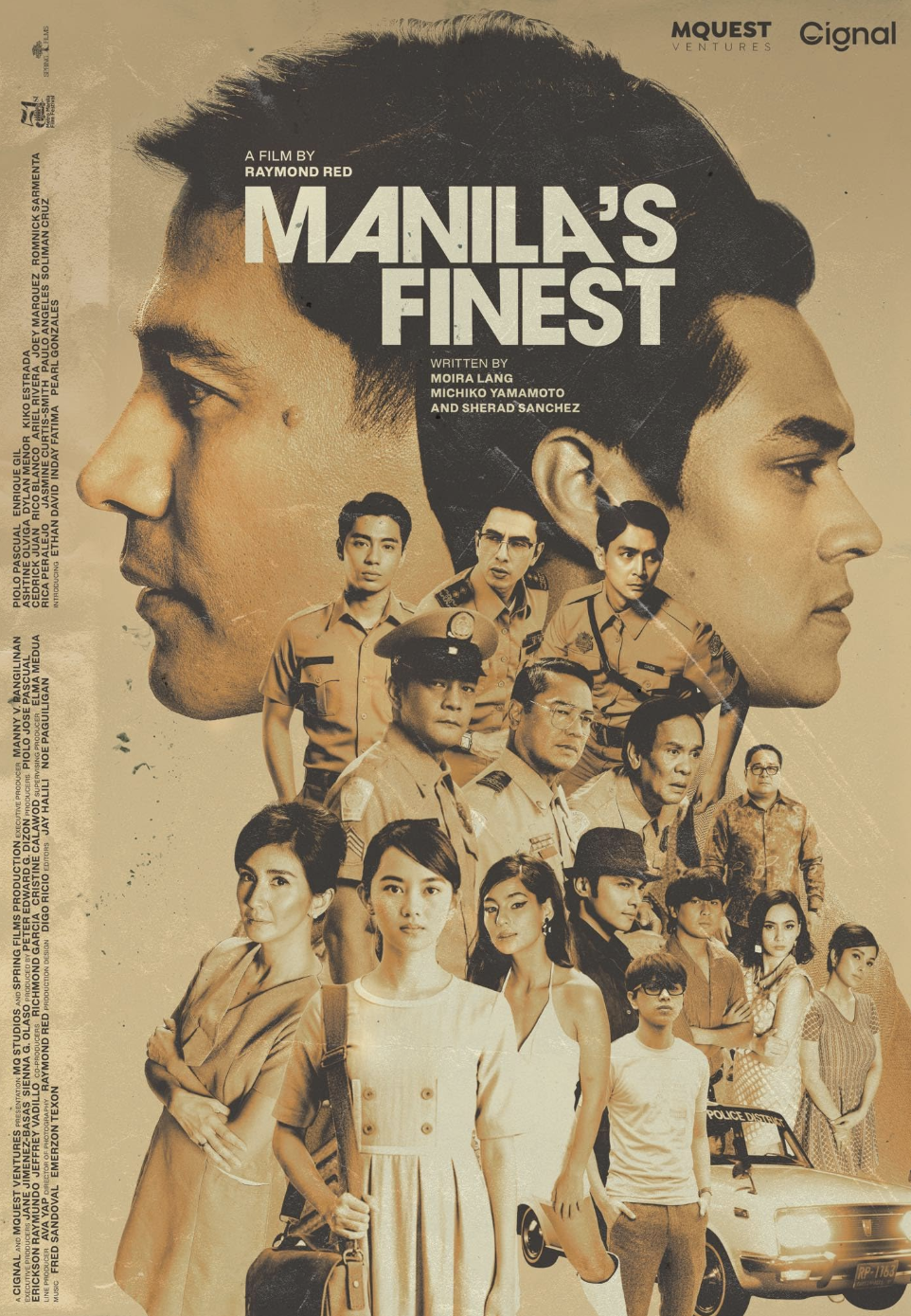
Photo Credit: Film Poster
This is a No Man is an Island film review written in collaboration with Cinema Escapist. Keep an eye out for more!
MANILA’S FINEST is a compelling look at the series of events that led up to the declaration of martial law in the Philippines under Marcos–though told from the perspective of, unusually, the Manila police. What emerges is a compelling narrative, even if, for critics, it may still err too closely to the viewpoint of the police.
Manila’s Finest follows Homer Magtibay, an honest, veteran police officer who is part of the Manila Police District. Homer is a family man with several children and a loving wife–even if he is conducting an affair on the side.
Homer finds himself at odds with the Philippine Constabulary Metropolitan Command (MetroCom), another branch of the police, after several mysterious killings. Though on the surface, it appears that two rival gangs have broken a truce and are killing each other, Homer suspects a setup–which seems to link back to MetroCom.
In the meantime, student protests against the incipient dictatorship are on the rise. Despite sometimes being called upon to act as the riot police in the midst of protests, Homer’s daughter Agnes is among those who participate in the demonstrations. Homer, then, finds himself navigating his role as a police officer in changing times, as the role of the police is more and more tarnished and morally ambiguous.
With high production values, Manila’s Finest does quite well in evoking Manila in the 1960s and 1970s. It is clear that a great degree of care went into the details of the setting, as well as the period atmosphere.


Manila’s Finest also distinguishes itself with its acting. Piolo Pascual’s turn as Homer manages to capture the complexities of his role. Other characters, such as Rico Blanco’s Epifanio Javier–a police chief that Homer finds himself contending with late in the movie–also stand out through subtle and nuanced acting.
If Manila’s Finest has a weakness, it may be a juxtaposition between “good cops” and “bad cops” in the narrative. Either way, Raymond Red’s movie is remarkable not only as a work of historical imagination but also as a gripping character drama.