


by Yang Jun-Dah
語言:
English
Photo credit: Yang Jun-Dah
THIRTY-SEVEN SUMMERS after its premiere, The Dull-Ice Flower《魯冰花》returns to Taiwan’s theaters. A beloved national favorite shot by acclaimed cinematographer Mark Lee Ping-Bing (李屏賓), the 1989 film was recently restored and digitized by the Taiwan Film & Audiovisual Institute (TFAI) and screened at the 2026 Cannes Film Festival in May as part of its Cannes Classics slate.
But it’s not just cinephiles who can rejoice: ongoing efforts in Taiwan for historic film rescue, film preservation, and re-releases mean that younger Taiwanese generations, Taiwanese diaspora and returnees, and foreign residents new to Taiwan can all encounter the country’s rich moviemaking history, from classics to rare archival footage alike.
But how are we as filmgoers in those categories to regard a movie such as The Dull-Ice Flower, outside its original time and absent the context of that era? Flower was made a mere two years after the Kuomintang (KMT) began to release Taiwan from decades of martial law oppression and censorship. And its source material, a novel by one of Taiwan’s literary giants, was published in 1960—even earlier in the White Terror era.
Taiwan Gothic
THANKS TO ITS heartwarming story and acting, Flower is an entrancingly enjoyable and deeply humanist movie, no matter your prior education on Taiwan history. Set in 1961 in an idyllic, tea-growing lakeside hamlet, the story centers on a fourth-grade boy, Ku Ah-Ming, and his sixth-grade older sister Ku Cha-Mei, as they row their bamboo skiff to and back from school. Ah-Ming is brimming with rambunctious lifeforce but dead last in class grades, while the quietly radiant Cha-Mei (Li Shu-Chen 李淑楨, who won a Golden Horse for her part) doubles as his maternal figure, shouldering schoolwork and housework while their indebted, bitter, widowed father toils in the tea fields and among the water buffalo.

Photo credit: Yang Jun-Dah
Entering their young lives is Art Teacher Kuo, newly assigned from Taipei to this countryside tableau. Kuo’s dashing looks and pitch-perfect Mandarin set him immediately apart from his middle-aged, rank-and-file male colleagues, who are either sycophantic buffoons or embarrassingly lusting after the women faculty. Kuo charms even the senior administrators, who grant him permission to start a special art class made up of talented students from each homeroom.
What makes Kuo truly different is his total disregard for the authoritarian, disciplinary education culture of that age—seeded by the Japanese colonial era and doubled down by the KMT’s subsequent grip over social norms. The militarized, formal salutes required of these precious primary school kids—“at ease” is merely another rigid stance—is met with a simple “Relax, really! Relax!” from Kuo, who also refuses to dole out corporal punishment. He meets the children’s needs through his own inner child—and is genuinely invested in their emotional lives and homefront struggles.
It takes a freed spirit like Teacher Kuo to recognize the same spark in Ah-Ming. Kuo soon realizes Ah-Ming is their diamond in the rough, someone constantly looked over yet is the true artistic genius among his peers, soaring with imagination and expression—and an empathetic eye observing the community around him, the hardships of farm life, and his sadly fading memory of his late mother. With a mentor’s pride, Kuo puts forth one of Ah-Ming’s works “The Tea Pests,” as the school’s entry to the district art contest.
Rich People’s Kids Are Better at Everything
KUO’S PRAISE for Ah-Ming is met with vociferous ridicule and threatened consequences on several fronts, involving everyone from Kuo’s teaching rivals to the wealthy township chief’s family. Everyone wants to nominate the wealthy family’s pampered young scion instead, to keep currying favor and climb the social ladder.
Ah-Ming is caught in this fray of adults and their castes and politics, their power over the powerless, and a society ruled by conformity. It is against this crushing weight that then-11-year-old Huang Kun-Hsuan (黃坤玄), portraying Ah-Ming, delivers the iconic line of the film:
「有錢人的小孩子,什麼都比較會。」 (Rich people’s kids are better at everything.)
Viewed at face value, Flower can be taken as a lens into Taiwan’s past. Quaint details like period-model bicycles, vintage Western fashion, painted portraits for campaigning politicians (and their casual election tampering), open-air classrooms, scratchy microphones at the school assembly, and grown-ups quick to punish with the switch.
But even new arrivals and returnees to modern-day Taiwan can appreciate how the era presented in Flower echoes still today—some aspects unchanged, others exacerbated or taken on different skins. Inequality then is contrasted by the earthen floors and wood-fire hearths in the farmer’s brick-laid home versus the township chief’s grand estate; today, it is overpriced 6-ping studios where landlords forbid you to cook, versus modest family apartments that modest families cannot afford (new construction luxury sky castles need not be mentioned). Ah-Ming and Cha-Mei’s father can barely pay back his debts while providing for his family; today’s Taiwanese struggling with depressed wages and soaring inflation are economically dejected from even wanting to start a family.
It is against this backdrop of inequality that any push for conformity feels even more fraudulent. The rigid frames of KMT education suppressed liberal thinking, taught revisionist history, and trained obedient workers ready to accept the state’s social contract—except for the party’s own wealthy elites who could send their children to private and international schools. Another poignant scene in the film finds Teacher Kuo walking out of judging a school oratory contest, where student speeches sang praises of dynastic Chinese poets. “What’s the point,” Kuo sighs, “When you all have written their speeches for them?”
Today, Taiwanese youth must still conform to a system where school grades dictate their future; office cultures can limit individualistic expression; and critical thinking is undermined by disinformation and AI slop—all while serving a socioeconomic reality overwhelmingly dominated by a powerful elite who control the very same systems and technologies.
(Spoiler warnings ahead, for those who wish to enjoy the movie first before continuing. )
Taiwan, Our Beloved Wayside Flower
TWO INTERPRETATIONS have been offered for the movie’s title.
The opening narration to The Dull-Ice Flower explains that the eponymous flower 魯冰花—the yellow lupine (Lupinus luteus)—was planted intentionally on tea farms. As lupines grow, blossom, and whither, they actually enrich the soils around them, benefiting and naturally fertilizing the tea plants.
As Ah-Ming’s fate unfolds in the film, we see him as the titular lupine. One laments: must there be a sacrificial body to shake a society beyond their conformity, so that others in the community may be enriched and grow to greater heights? We learn too, that Teacher Kuo has made sacrifices, facing the consequences for repeatedly punching the system in the face in standing up for his humanist values.
The other interpretation refers to a folk pun on the lupine’s Mandarin name.「魯冰花」is pronounced lu bing hua—a phonetic transliteration of “lupine flower”—which also sounds like the pronunciation for「路邊花」in Mandarin, Hakka, and Tâi-gí—meaning “wayside flower” or more colloquially, someone who is unimportant and overlooked.
Ah-Ming, Cha-Mei, and Teacher Kuo are certainly the overlooked wayside flowers of their time—alongside many others whose exceptional brilliance is smothered by conformity, or worse, targets them for erasure by the system. Chung Chao-Chung (鍾肇政), the author of The Dull-Ice Flower whose works were foundational to Taiwanese xiangtu literature, himself said he was under watch by the KMT secret police once the 1960 novel began sparking social debates. And just years earlier, Chung and other writers and poets had to shutter their short-lived literary friendship newsletter as martial law scrutiny amplified.

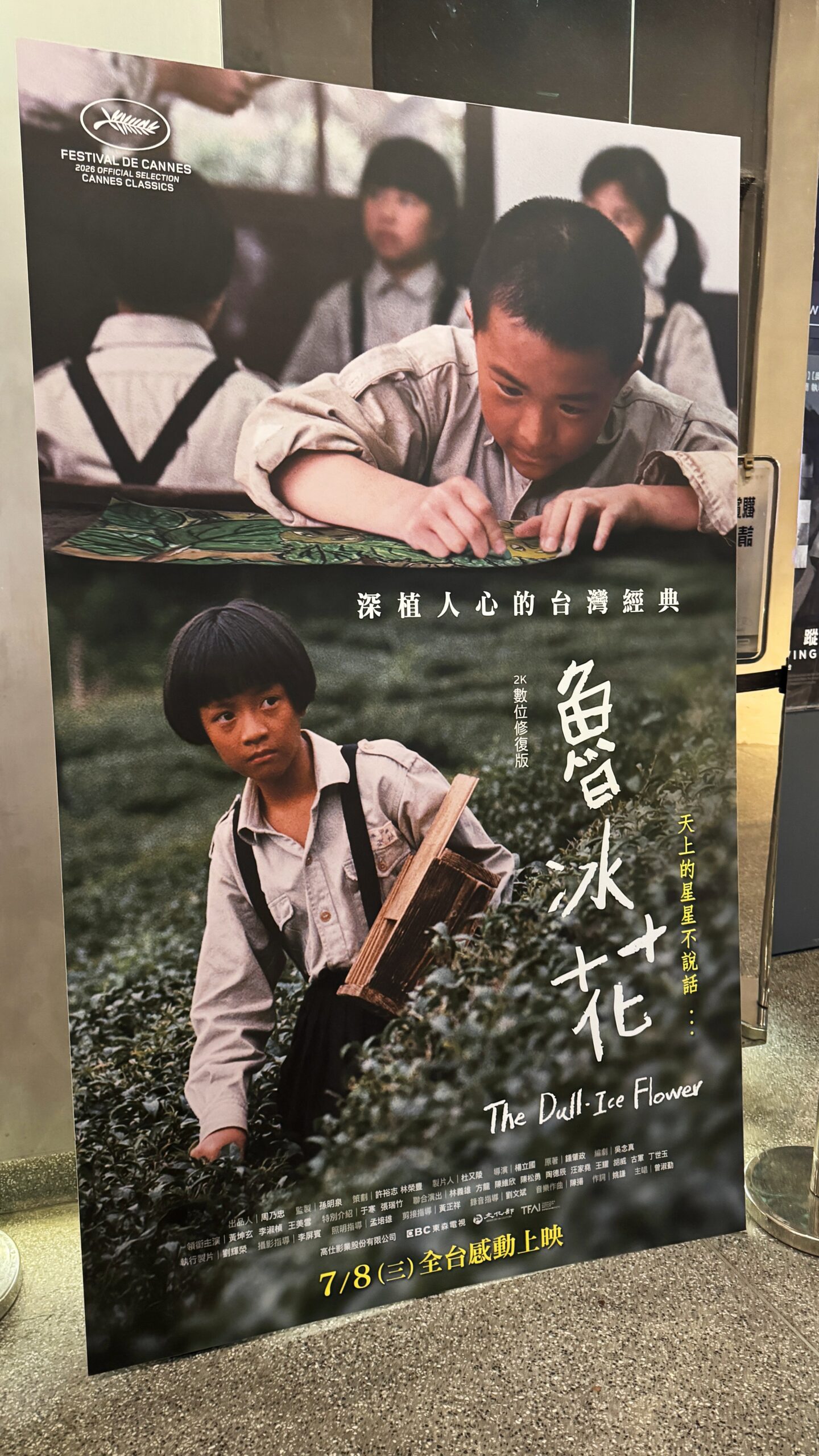
Photo credit: Yang Jun-Dah
For readers and viewers deeper into their Taiwanese studies: Would it be too pessimistic to see Taiwan, too, as the sacrificial wayside flower? Are we, some 23 million people, many of whom were simply born into today’s geopolitical quandary, also intended to blossom then whither first, in order for there to be peace and liberation on Formosa? Are we merely pawns in the continued struggle of powers, conforming to serve one nationalist system after another, our everyday toils merely existing to give rise to the next oligarchy?
Or should we hold the spirit of lu bing hua alongside that of wild lilies, strawberries, and sunflowers, hoping that with each cycle of our work, we nourish our own harvest of believers and survivors, so that all can blossom and carry on?