

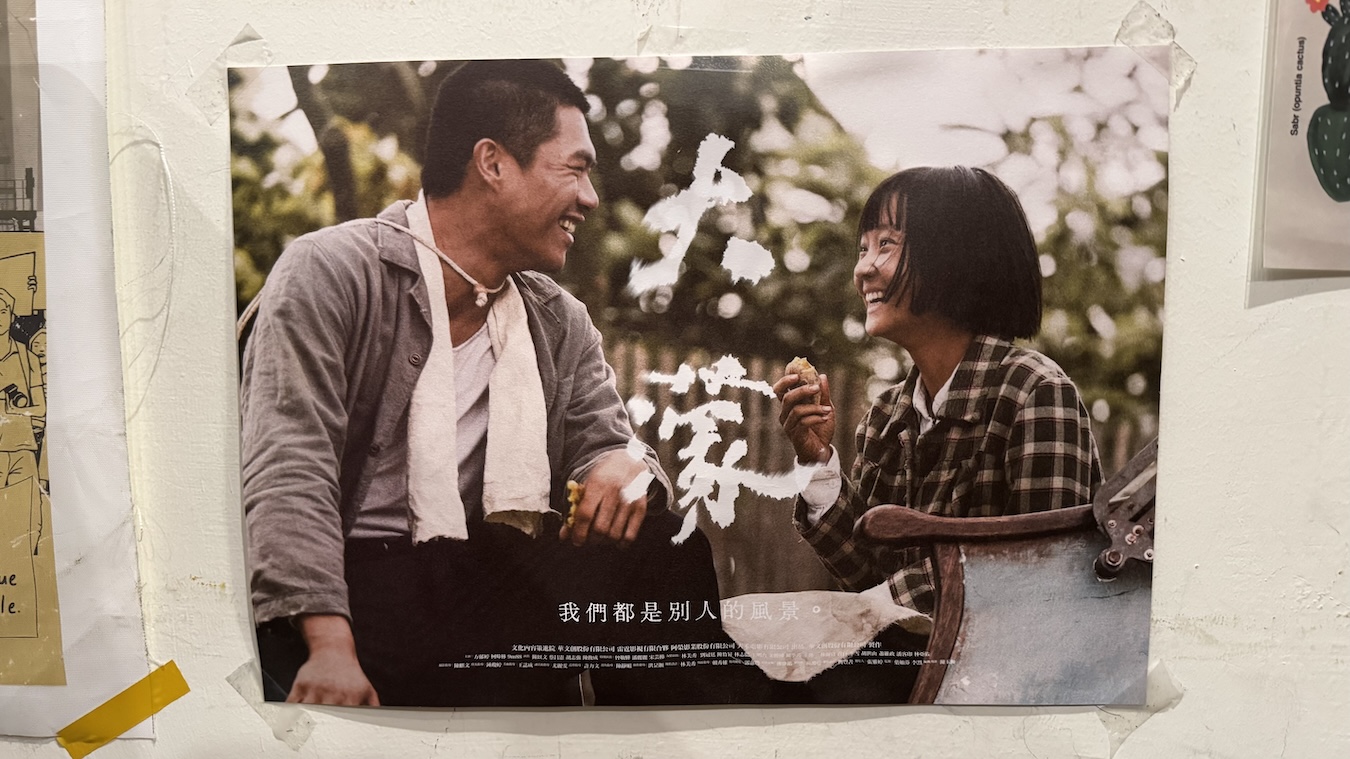
by Yang Jun-Dah
語言:
English
Photo credit: Yang Jun-Dah
A RECENT SOCIAL MEDIA phenomenon in Taiwan has been「補課」(Bu-ke) and「台灣史補課」(Taiwan lishi bu-ke)—roughly “make-up class” or “make-up homework”—wherein open-minded Taiwanese twenty-somethings have been fervently reaching for any kind of historical content, both factual and artistic, to reeducate themselves on Taiwan’s dark past. And as any Taiwanology novice must learn, that past refers to the “White Terror” period from 1949 to 1992, when the Kuomintang (KMT) government enforced martial law by persecuting, jailing, and executing intellectuals, journalists, artists, pro-democracy and pro-independence activists, and any other civic leaders challenging their autocratic rule.
This current “Bu-Ke” wave was instigated by the controversy surrounding Murder of the Century《世紀血案》— a Taiwanese movie production based on the real-life murder of a pro-democracy activist’s daughters in 1980. Murder had wrapped principal photography, but a February 1, 2026 press conference intended to build publicity instead revealed that the movie is a revisionist take that deflects responsibility from the KMT perpetrators of the titular crime–among other ethical missteps relating to the victims’ living family.
While Murder has been indefinitely shelved, a different film portraying the White Terror period has played to critical accolades. A Foggy Tale《大濛》premiered in November 2025 and by quirk of industry mechanics, also took home major wins at the 62nd Golden Horse Awards that same week, including Best Film.
An Immersive Time Machine of Taipei Life
I TOOK IN A Foggy Tale at the cinema this past February 28 as my own Bu-Ke ritual. The film was mostly out of circulation three months after its premiere, save for special screenings around 228. In the crowded theatre, my friend and I resorted to sitting in the very first row, putting us face-first with the screen.
By happenstance, these neck-tilting seats made for a devastatingly immersive viewing experience. Directed and written by Chen Yu-Hsun (陳玉勳), who also took home a Golden Horse for Best Screenplay, A Foggy Tale makes use of a richly designed outdoor set, location shots, and computer graphics to recreate Taiwan of the 1950’s. The story follows Ah-Gua̍t, a 15-year-old orphaned girl, who travels from rural Chiayi to the capital of Taipei to fulfill a heartbreaking mission.
This Taipei is cacophonous, dusty, and perilous, not with speeding cars and scooters or neon billboards, but with oxcarts, pedicabs, bicycles, chauffeured cars, military jeeps, and street hawkers, hustlers, and American GIs among them. In the shadow of the old Taipei Main Station, major boulevard names familiar to today’s MRT riders are heard—but seen as maze-like alleys full of ragged shingled shacks and brick-and-bamboo storefronts, held together with mortar, twine, and hope. There is an incredible shot in the film where the camera view rises above the Taipei cityscape–but there is no city skyline: Taipei is a misty expanse of green tree-tops stretching into the horizon straight out to Tamsui and Guanyinshan, interrupted only by the protruding tower of the Presidential Office Building.
Re-Educating Generations at Home and in Diaspora
TODAY BU-KE is “make-up homework” precisely because the KMT held absolute power for decades, maintaining censorship of information and control over education, and suppressing dissent. Even when files from the martial law era have been declassified, there were likely many reams more that were already intentionally destroyed.
I myself am taking up Bu-Ke because I am of the「七年級生」generation—Taiwanese slang for child of the 1980s (Republic of China Year 70-79), those final years of White Terror. My education in a Taipei public school was still one of ancient Chinese dynasties and Koxinga’s exploits, plus one zealously anti-Japanese homeroom teacher. Tâi-gí was spoken at home by my southerner parents and relatives, but I never learned it.
What’s more, I would spend the rest of my formal education in the United States, where “Taiwan” was at best a brief sidebar in American history textbooks. I remember visiting family in Taipei one spring in the early 2000s and noticing a three-day weekend on the calendar around “February 28” and I had to naively ask why there was a new holiday. The best answer I got then was, “It’s something from a long time ago.”
Today’s Taiwanese diaspora is more fortunate. Despite no major North American distribution, privately organized screenings of A Foggy Tale by diaspora organizations have been popping up in cities spanning Boston, Pittsburgh, San Francisco East Bay, and Seattle, with the latter specifically namedropping the Bu-Ke wave.
But in essence, I am as in need of Bu-Ke as this generation of local Taiwanese, those who were born after liberalization, seemingly disconnected from this history.
Taiwan’s Past As Present
THE LESS YOU know about A Foggy Tale, the better the film plays. I myself attended the screening without watching the trailer, and I recommend the approach.


Spoilers below, then, for those who wish to read on.
Early in the story, the main character, Ah-Gua̍t, is lovingly asked to imagine what her life would be like when she grows older, into her twenties, her thirties, perhaps even her seventies as an old grandmother. As we expect end credits to roll, we are gifted with a photo montage of these very milestones—before the film suddenly resumes, with an elderly Ah-Gua̍t in the flesh.
We, the audience, see Ah-Gua̍t watch modern Taiwan unfold in democratization through the 1990s and 2000s. We see her relive the White Terror again when she hears news of rediscovered graves and unidentified remains. And soon, we realize that Ah-Gua̍t’s reality is in fact our own, and she exists in our time and in our timeline.
This goes to demonstrate those human rights horrors are not a distant past: they are the real memories and lived experience of our parents and grandparents (Ah-Gua̍t would be in her mid-80s now)—who then emoted their learned taboos around their children and grandchildren.
To be Taiwanese is to be connected to White Terror, either to the persecutors or the persecuted, because the crimes continued on for so long and their resulting trauma was so pervasive throughout society. And those perpetrators lived among us then and now still, from the bureaucrats to the foot soldiers to the executioners. Some were engaged in that work for decades, and most never had to answer for it. And the KMT remains a preeminent party in Taiwan, still trying to write Taiwan’s future while quietly rewriting their complicity.
For all of us, the make-up class continues. If only to understand what was lost, so we can appreciate what we still have to lose.